

Table of Contents
A commercial crash can leave you facing serious injuries, lost income, and several insurance companies at once. The size and weight of a truck can also change how the crash happened and who may share fault. We explain the filing steps, evidence needs, coverage questions, and Utah deadlines that can shape your claim. For additional information about pursuing a Utah truck accident claim, review the legal issues that may apply to commercial crashes.
Step 1: Get Medical Care and Report the Utah Commercial Vehicle Crash
Your health comes first after a commercial vehicle crash. Get emergency care when needed, then follow up with a medical provider even if your symptoms seem mild.
Truck and bus crashes can cause injuries that appear later. Neck pain, back pain, concussion symptoms, and internal injuries may not show at the scene. Tell each provider how the crash happened and describe every symptom clearly.
Utah uses a no-fault system for the first layer of injury coverage. The policy covering your vehicle generally pays medical expenses through personal injury protection, or PIP. After that, a claim against the at-fault party may be available when Utah law allows it.
Report the crash to law enforcement when required. Ask how to obtain the report once it becomes available. Write down the date, road, direction of travel, weather, traffic conditions, and what you remember before the details fade.
You may deal with your own insurer and the commercial carrier’s insurer. Those are different claims. Your own policy creates a contract with your insurer, while a third-party claim is made against the insurer for the other driver or company. The personal injury lawyer Utah clients rely on can help keep those claims separate.

Step 2: Preserve Evidence Before It Disappears
Evidence can vanish while you are still recovering. Start a file on the day of the crash, then add records as they arrive.
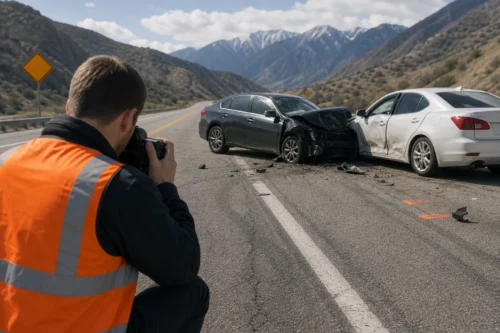
Save photos of the vehicles, roadway, debris, lane marks, traffic controls, and your visible injuries. Keep the original files when possible. Do not edit the images or add filters. Note who took each photo and when. A Utah car accident evidence guide can help you organize the records that may support liability and damages.
Ask witnesses for their names and contact details. Do not pressure them to take sides. A short account of what they saw can help later, especially when the truck moved before impact or blocked your view.
Commercial vehicle cases often need records that passenger-car cases do not. Those records may include:
- Driver qualification and training files.
- Electronic logging device data and driver logs.
- GPS location records and dispatch messages.
- Dashcam or roadway camera footage.
- Inspection and repair records.
- Load, cargo, and maintenance records.
- Onboard computer data from the truck.
Send the truck owner, carrier, and insurer a written preservation request as soon as possible. This request tells them to keep records tied to the crash. It should cover electronic data, video, driver records, maintenance files, and the vehicle itself.
Do not rely on a routine police report to gather all of this material. A report may record the scene and statements, but it usually will not include a carrier’s internal records. We at LeBaron & Jensen, P.C. can review the parties involved and identify which records may need a formal preservation demand.
Keep a daily loss log. Record medical visits, missed work, pain levels, sleep problems, and tasks you cannot perform. A plain account is more useful than a vague statement that the crash affected your life.
Tire condition can matter when a blowout or worn tread may have contributed to a crash. For maintenance education, truck owners can review a guide to measuring truck tire tread depth. That resource does not replace an inspection by a qualified professional.
Preservation has a time limit in many cases. A carrier may delete routine electronic records under its normal retention policy. If you wait, the missing data may become harder to recover or explain.
Step 3: Identify Every Potentially Responsible Party and Available Coverage
A commercial vehicle accident claim in Utah may involve more than the person behind the wheel. List each possible party before you focus on one insurer.
The driver may be responsible for speeding, distraction, fatigue, poor lookout, or unsafe lane movement. But the carrier may also share fault if it hired an unqualified driver, skipped training, ignored safety warnings, or pushed an unsafe schedule.
Mechanical failure creates another path. A maintenance company, repair shop, parts maker, or vehicle owner may face a claim if a defective part or neglected repair caused the crash. Cargo problems matter too. An overloaded or poorly secured load can change stopping distance and vehicle control.
Start with the company name shown on the truck. Photograph the unit and trailer if you can do so safely. Record the driver’s name, employer, vehicle number, plate information, and insurer details. A leased truck may have several business names connected to it.
Coverage may come from more than one policy. Possible sources include applicable commercial insurance policies and other available coverage. The policy limit is only one part of the review. Exclusions and definitions can affect payment.
Employment status can also matter. A company may call a driver an independent contractor, but that label does not answer every liability question. Review the workers’ compensation information for applicable rules on coverage waivers.

Comparative fault can reduce a recovery. Utah generally permits recovery when the injured person is less than 50 percent at fault, with the award reduced by the person’s share of fault. The insurer may argue that your speed, lane position, or conduct caused part of the crash. Evidence should answer that argument.
For example, a truck may strike your car after drifting across a lane. The carrier may claim you were traveling too fast. Photos, vehicle damage, event data, witness accounts, and road measurements can help show what each driver did before impact.
Step 4: Calculate Damages and Handle Insurance Adjusters Carefully
Insurers may move quickly after a commercial crash. Your claim needs a full damage record before you discuss a final settlement.
Economic damages are losses with a clear dollar value. Gather medical bills, health insurance statements, prescription records, travel costs, wage records, and proof of missed work. If your injuries affect future work, household tasks, or earning capacity, keep records that show the change.
Non-economic damages cover losses such as pain, emotional distress, loss of normal activities, and reduced quality of life. Your daily log can help show how the injury affects sleep, family duties, exercise, and work. Do not exaggerate. Clear details carry more weight than dramatic language.
Property damage needs its own review. You can choose a repair shop instead of using the shop suggested by the insurer. If your selected shop charges more, the insurer may dispute the difference.
Ask for an itemized estimate. Utah insurance guidance addresses deductions for betterment, old damage, and non-original equipment manufacturer parts. A newer replacement part may improve an older vehicle, so an insurer may seek a deduction. Any deduction should be explained in writing.
Do not sign a release until you know what it covers. A bodily injury release can end your right to seek more money from that party. You may be able to resolve property damage while medical treatment continues, but that does not mean you should close the injury claim.
Be careful with recorded statements. Give accurate facts, but do not guess about speed, distance, fault, or future treatment. You can ask what the statement concerns and seek advice before making one.
LeBaron & Jensen, P.C. helps clients organize damage records and assess settlement discussions. We take the stress off your plate while keeping the focus on a fair settlement and your rightfully deserved compensation.
Step 5: Meet Utah Deadlines and Pursue the Claim With Legal Help
A settlement discussion does not stop every legal deadline. Put the filing date on your calendar and confirm it with a Utah attorney.
Many Utah personal injury claims have a four-year filing period, but the correct deadline depends on the facts and parties. Claims involving government entities may follow different rules. Wrongful death claims also have their own deadline. Do not assume the date is simple because the crash date is clear.
Insurance talks can continue for months. That time does not guarantee that a lawsuit will remain available. A written demand letter also is not the same as filing a complaint in court.
Before filing, the crash facts, medical records, coverage, fault arguments, and damages should be reviewed. We may contact the carrier or its insurer, request records, and prepare a demand. If the insurer will not make a fair settlement offer, litigation may be the next step.
A lawsuit begins with a complaint. The other side then responds. Discovery may require written questions, document requests, depositions, and expert review. You may need to explain the crash and your injuries under oath. Good records make that process easier.
Our team at LeBaron & Jensen, P.C. handles personal injury matters for Utah individuals and families. We can also discuss commercial truck cases tied to communities near the state line, including Truck Accident Attorney | Uintah UT | LeBaron & Jensen when that location is relevant.
Do not wait for every record before seeking legal guidance. Early review can help preserve evidence, identify the right defendants, and prevent an insurer’s position from becoming the only version of events.
Coverage waiver questions can involve business documents and may require careful review. That detail matters when a company claims a worker had no employee status. Review the agency’s coverage waiver requirements alongside advice about your specific claim.
Take action before the file gets cold. A prompt legal review may protect options that become harder to recover later.
FAQ
How do I file a commercial vehicle accident claim in Utah?
Start by getting medical care, reporting the crash, and notifying the proper insurers. Preserve photos and records before discussing a final settlement. A commercial vehicle accident claim in Utah may involve the driver, carrier, owner, maintenance company, or another party. An attorney can help identify claims and protect the filing deadline.
Does Utah have no-fault insurance after a truck crash?
Yes, Utah generally requires the policy covering your vehicle to address the first layer of medical expenses through PIP. Medical expenses are commonly handled this way. A commercial vehicle accident claim in Utah may still proceed against a responsible party when the legal requirements for an injury claim are met.
How long do I have to sue after a commercial crash in Utah?
Many Utah injury claims have a four-year limit, but the correct period depends on the parties and facts. Government claims and wrongful death cases may follow different rules. Do not rely on a general estimate. Have LeBaron & Jensen, P.C. review the crash date and possible defendants before the deadline becomes urgent.
What evidence helps prove a commercial truck accident claim?
Useful evidence can include photos, witness accounts, medical records, driver logs, GPS data, dashcam footage, maintenance files, and onboard vehicle data. A commercial vehicle accident claim in Utah may require a written preservation request because some business records are kept only for limited periods.
Should I accept the truck insurer’s settlement offer?
Do not accept a final offer until you understand your medical outlook and the release terms. The settlement may end your right to seek more money from that insurer or party. Compare the offer with medical costs, lost income, future needs, and non-economic losses before signing anything.
Conclusion
After a commercial crash, protect your health first, then preserve evidence and track every loss. Because several parties and policies may be involved, early advice from LeBaron & Jensen, P.C. can help protect your claim. Gather your crash report, medical records, photos, and insurer letters before your consultation so the next step is clear.